

You have heard the saying that “beauty is in the eye of the beholder”, this is true for a lot of things including symbolism. What does this mean? It means that symbolism is interpretive and as you know interpretations can vary based on the filters they are put through. Two common filters are perception and belief. How you perceive something or believe something is based on what is known to you. Would it be true that through seeking and gaining knowledge, that one’s current perception and/or belief could be modified or changed thus changing your interpretation of a symbol?
What is symbolism?
This can be answered by looking at the meaning of the words involved. The first is the word symbol. What is it? It can be an action, object, event, etc. that expresses or represents a particular idea or quality. This brings us to the second which is ism. Ism is added to a word as a suffix to express a specific practice or process of action or behavior. So, what is symbolism? It is the use of symbols to represent ideas or qualities by giving them symbolic meanings that are different from the original meaning.
What can symbolism do to a symbol?
It is common practice for symbols to be used by groups to represent themselves, their actions, or their ideology i.e. logos, etc. Logos are used for the purpose of recognition, for easy identification. They can contain one or more symbols that are usually adopted as is or modified in some way. Let’s look at my original logo as an example. It is representative of me and my work. There are 7 components within it. Each one has meaning… spiritual meaning and has been part of my spiritual journey. It consists of:
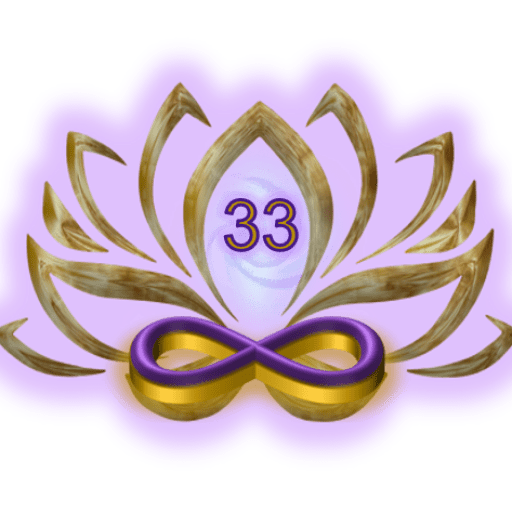
The lotus flower is a symbol of spiritual enlightenment. The infinity symbol represents endlessness and eternity. The swirl inside the petal (behind the number) represents a portal/vortex of energy. The Master Number 33 is my life path number. Purple is my favorite color but it is representative of spirituality. It is said that purple symbolizes the bridge between the physical and spiritual worlds. The color gold represents knowledge and transformation and the glow representative of an energy field.
(it has since been updated using the components)
What happens when a symbol is used to represent ill will? Symbols used in this manner are usually tarnished by it. These symbols are usually controversial. The stigma that is associated with the symbol is what is remembered and taught. The original meaning as a result is lost from common knowledge. An example of this is the swastika. This is a symbol that was adopted and stigmatized. When seen or mentioned, what is the first thing that comes to mind? Hitler and the Nazis? White supremacy? What about the atrocity called the Holocaust? World War II? It is because of this that this symbol is deemed sinister. Did you know that the adoption of the swastika for the Nazi regime was based on the mistaken belief that it was a symbol of a pure Aryan race? How many people do you think know the origin of this symbol and its meaning?
The swastika is an old solar symbol; it goes back to the Neolithic times; different forms of it have been used like by the Navaho and Hopi Indians and it was used wide spread in India, Northern Europe, Central America and East Asia; “swasti” means “well being” or “so be it”; the arms resemble a wheel, able to rotate in either direction – arms pointed to a clockwise direction symbolized the sun, the male principle & the overt while one with the arms pointed to a counterclockwise direction symbolized the moon, the female principle & the covert; the 4 arms are representative of the 4 corners of the world, 4 seasons, 4 directions and 4 elements.
(source: The Element Encyclopedia of Secret Signs and Symbols by Adele Nozedar)
As you can see by the example, the original meaning of a symbol can be lost by the adoptive representation to something else. It seems that it is still used based on the mistaken belief. You can also see by the example, that the adoptive meaning may not even be close to or in the same ball park as the original meaning. Years ago, I wrote an article about this concept as it pertained to the adoption of the cross in religion. (The Cross)
Here are a few examples of symbols with meanings. Is your meaning the same or similar for each?
Cross
union of material & spiritual / symbol of protection

Doorway
transition between worlds / threshold is where worlds meet and can collide

Peace Sign
Campaign for Nuclear Disarmament, 1958 UK / brought to US & used in civil rights demos, 1960’s / became an universally accepted symbol for peace

Pentagram
5 pointed star – found in the center of an apple / 5 pts believed to represent earth, air, fire, water & ether or justice, mercy, wisdom, understanding & transcendence
How do symbols offend?
When a symbol is associated with personally or socially unacceptable events, actions or beliefs (ideology), is it the symbol that is offensive? Isn’t it the meaning associated with the symbol or what the symbol is perceived to represent that is the trigger for offendedness?
“To be offended by something is actually to be offended by yourself.”
It is not the symbol that is offensive… it is your perception of the symbol that offends.
It is you who gives power to outside sources and only you who can take it back.
So is this not you offending you?
There has been controversy surrounding statues, monuments and other symbols in recent years. The actions of vandalizing, covering and removing them serves what purpose? Do these actions move society forward or backward? Neither these actions nor the emergence of what is called “cancel culture” moves anything forward and proves that an imbalance exists. To move forward a sense of balance needs to be restored in society. This can begin through the process of healing by teaching and learning how not to be offended. I wrote an article not too long ago entitled “Offendedness“.
Do you seek truth?
As you can see, this question applies to symbols as they can be mistakenly used or deemed offensive. It is unfortunate that truth is not always sought. This also applies to life in general. Truth can sometimes be difficult to find. This truth pertains to all areas of life… personal, spiritual, historical, social, political, global, etc. Seeking truth takes time and effort however, finding truth is worth it. Sometimes getting to the truth is complex. You must be open-minded. You must be able to look at all that pertains to the truth you seek and determine what is fact, opinion, interpretation, perception, perspective and falsehoods. Next, determine what has merit and what what does not. Truths have been buried, altered and only partially told. There are many who do not seek truth for themselves instead they rely on the opinions and interpretation of others deeming it as truth for themselves when it may not be. Even when truths are presented, some if not many have a difficult time believing it. Do you seek truth or do you go along to get along? Do you seek truth or do you follow the crowd? Do you seek truth or do you concede to the loudest voices? Do you seek truth or do you believe the narrative being repeated? Do you seek truth or do you sustain talking points? Do you seek truth or do you trust the media? Do you seek truth or do you conform to “influencers”? It is important to be an independent thinker. Your thoughts may be like-minded but they are yours. Your thoughts may be different-minded but they are yours. Independent thinking simply means that you think for yourself.
Symbolism is in the eye of the beholder because it is interpretive. Always remember that your power lies in what you can control. You can control your interpretations. You can control what you allow yourself to internalize. You can control your beliefs. You can control your thoughts. You are able to control yourself. Is it truth to say that seeking and gaining knowledge can change or modify the filters you use to make your interpretation thus changing your interpretation as well?
Blessings of Love & Light,
RKB
 RK Benedict | Spiritual Energist-Author
Share your thoughts…